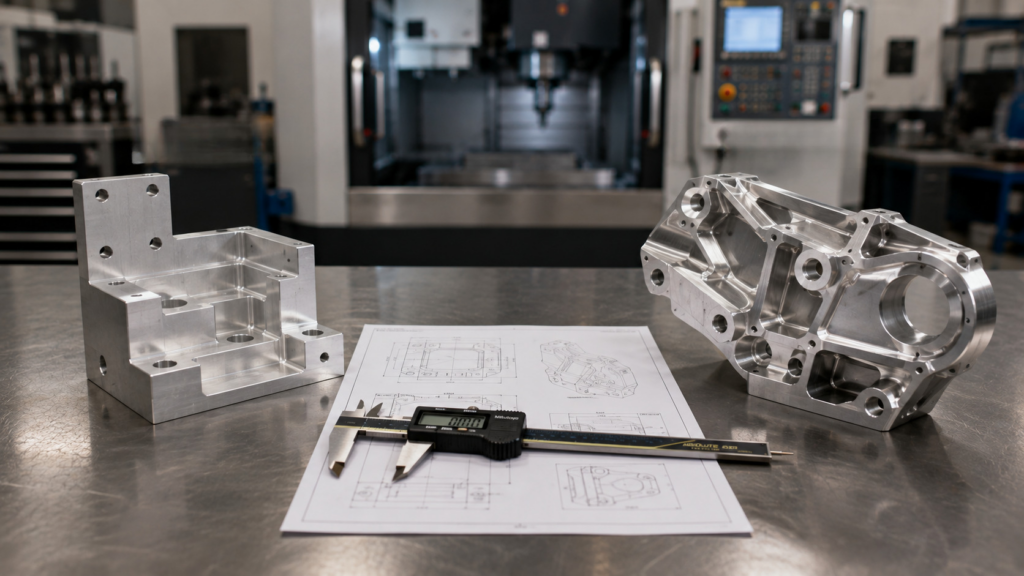
If you’re sourcing custom machined parts, you’ve likely come across 3-axis and 5-axis CNC milling. While both are capable of producing precision components, they’re designed for different types of part geometries. Choosing the right process can help reduce machining costs, improve manufacturing efficiency, and ensure your part is produced using the most practical approach.
In this guide, we’ll explain the differences between 3 axis vs 5 axis CNC milling, when each process makes the most sense, and how understanding the trade-offs can help you make more informed sourcing decisions.
What Are 3-Axis and 5-Axis CNC Milling?
Both 3-axis and 5-axis CNC milling use computer-controlled cutting tools to remove material and produce precision parts. The difference lies in how the cutting tool accesses the workpiece.
In 3-axis milling, the cutting tool moves along the X, Y, and Z axes to machine features from one direction at a time. If additional faces need to be machined, the part is typically repositioned between operations.
In 5-axis milling, the machine combines movement along the X, Y, and Z axes with two additional rotational axes. This allows the cutting tool to reach multiple sides and complex angles in fewer setups, making it well suited for more intricate part geometries.
How Part Geometry Influences the Best Milling Process
Part geometry plays the biggest role in determining whether 3-axis or 5-axis milling is the better manufacturing choice.
A simple bracket with flat faces, drilled holes, and standard pockets doesn’t require the same machining strategy as an aerospace component with compound angles or complex curved surfaces.
Instead of asking, “Which machine is better?”, buyers should ask:
“Which process can manufacture my part accurately while avoiding unnecessary machining time and cost?”
That’s where understanding the strengths of each process becomes valuable.
When 3-Axis Milling Is the Right Choice
For many manufacturers, 3-axis milling is the workhorse of CNC machining because it efficiently produces a wide range of precision components.
It’s often the best choice for parts with:
- Flat surfaces
- Pockets
- Slots
- Drilled holes
- Rectangular or prismatic geometries
- Features that can be machined from one or a few orientations
Examples include:
- Mounting brackets
- Machine plates
- Electronic enclosures
- Fixture components
- General industrial parts
Because these parts require relatively straightforward machining strategies, 3-axis milling typically offers the most economical solution.
Using a more advanced machining process for these designs often increases programming complexity and machine costs without improving the finished part.
When 5-Axis Milling Adds Value
Parts with complex geometries often require machining on multiple faces or at compound angles. In a traditional 3-axis setup, these features may require several repositioning operations, or “setups,” before machining can be completed.
Each additional setup adds time and introduces another opportunity for slight variation between operations.
With 5-axis milling, the cutting tool can access more areas of the part in a single setup, making it well suited for components with:
- Complex contours
- Multiple machined faces
- Compound angles
- Deep cavities that require improved tool access
- Tight feature relationships across several surfaces
It’s important to understand that 5-axis milling isn’t inherently “more accurate” than 3-axis milling. Instead, its primary advantage is the ability to machine complex geometries more efficiently by reducing setups and improving tool access. When those capabilities aren’t needed, a simpler machining strategy may provide the same end result.
Recommended reading: What Is 5-Axis Milling?
The Cost Trade-Off Buyers Should Understand
For buyers, the biggest difference between 3-axis vs 5-axis CNC milling often comes down to cost.
5-axis machining centers are sophisticated pieces of equipment that require advanced programming and specialized machining strategies. As a result, their hourly machine rates are typically higher than those of standard 3-axis machines.
However, that doesn’t automatically make 5-axis machining the more expensive choice.
For complex parts, machining multiple faces in a single setup can reduce production time, minimize handling, and improve overall efficiency. In these situations, the savings gained from fewer setups may offset the higher machine rate.
On the other hand, if your design consists primarily of flat surfaces, pockets, slots, and drilled holes, specifying 5-axis machining may simply increase manufacturing costs without improving the finished part.
The most cost-effective solution is the one that matches the complexity of your design.
Should You Choose 3-Axis or 5-Axis CNC Milling?
If your part has a simple prismatic design with flat surfaces, pockets, slots, and holes, 3-axis CNC milling is typically the most cost-effective option. 5-axis CNC milling is better suited for complex geometries, multiple machined faces, and intricate contours where fewer setups can improve efficiency and accuracy.
Understanding your part’s geometry is the first step toward selecting the right process.
Side-by-Side Comparison
| Consideration | 3-Axis CNC Milling | 5-Axis CNC Milling |
| Best for | Prismatic parts, brackets, plates, housings | Complex parts with multiple faces or compound angles |
| Part Geometry | Flat surfaces, pockets, slots, holes | Organic shapes, deep cavities, intricate contours |
| Machining Setups | May require multiple setups | Often completed in fewer setups |
| Programming Complexity | Lower | Higher |
| Typical Cost | Lower for simple parts | Higher machine rates, but can reduce cost on complex parts |
| Ideal Applications | General industrial, electronics, brackets, plates, housings | Aerospace, impellers, medical, high-performance applications |
Still Not Sure Which Process Fits Your Part?
Choosing the right milling process starts with understanding your part’s requirements. When you request a quote from PartsBadger, your design is reviewed as part of the quoting process to help ensure the recommended manufacturing approach aligns with your geometry, quality requirements, and production goals.